

Compare the question you want answered before comparing products
Someone searching for NAD+ therapy in Houston may also see B12 shots described with energy-related language. That does not make the services interchangeable. They involve different substances, different routes or appointment formats, different clinical considerations, and different prices. Start by explaining your reason for asking. Are you trying to understand a proposed treatment, compare a menu, investigate persistent fatigue, or coordinate care already recommended by your clinician? Those are different questions. A good consultation should identify the relevant question before presenting a purchase decision between two product names. You may discover that neither elective option is the appropriate next step.
RapidRefresh lists both a Vitamin B12 Injection and NAD+ Renewal on its pricing page. This comparison uses that menu as a business reference checked October 15, 2026, while using independent sources for the limited scientific and regulatory discussion. The menu establishes what the business advertises and the stated starting figures. It does not establish that either service is necessary for you, prove a health outcome, or replace an assessment. Keep those categories separate when reading an online article, a testimonial, or a social-media clip. A clear price can be useful even when a clinical question remains unresolved.
What is different about B12?
Vitamin B12 is an essential nutrient with established clinical relevance to deficiency. The NIH Office of Dietary Supplements describes prescription B12 preparations and notes that some deficiency situations are managed with injections, while oral approaches may also be appropriate. That does not mean every tired person needs an injection. The choice depends on the clinical circumstances. Ask your clinician about the reason for a proposed B12 service, the product and route, and how it fits any existing care plan. This guide does not determine your B12 status or recommend a personal treatment schedule.
The useful distinction is between addressing an identified clinical need and purchasing a service because a familiar nutrient sounds reassuring. If a clinician has diagnosed a deficiency, ask how the proposed appointment relates to that diagnosis and any planned monitoring. If no deficiency has been established, do not use a symptom checklist or a product advertisement to fill the gap. Be candid about what you want to understand. A qualified clinician may recommend assessment, a different approach, or no elective service. The familiar name "B12" does not remove the need to explain what is being administered and why.
What does NAD+ research actually show?
Research about NAD+ can sound compelling because the molecule is involved in cellular processes. However, a substance having an important biological role does not establish that an infusion improves a particular person's symptoms or long-term health. A 2019 pilot study of intravenous NAD+ examined changes in plasma and urine metabolites during a six-hour infusion protocol. That is a specific research question and study design. It should not be presented as a trial proving that a commercial wellness service reverses aging, improves workplace performance, or produces a guaranteed energy benefit. Those broader conclusions do not follow from measuring metabolites in a pilot study.
When you encounter a claim, ask what was measured, who was studied, and whether the study used the same product and route being offered. A change in a laboratory measurement is different from a meaningful improvement in daily functioning. Short observation is different from evidence about long-term outcomes. Evidence from an oral precursor is not automatically evidence for an IV preparation. These are research-reading principles, not a verdict about your individual situation. The practical application is to request an explanation of the evidence for the specific claim, and to remain comfortable saying that the available explanation does not justify an elective purchase for you.
Compare the listed prices without ranking the treatments
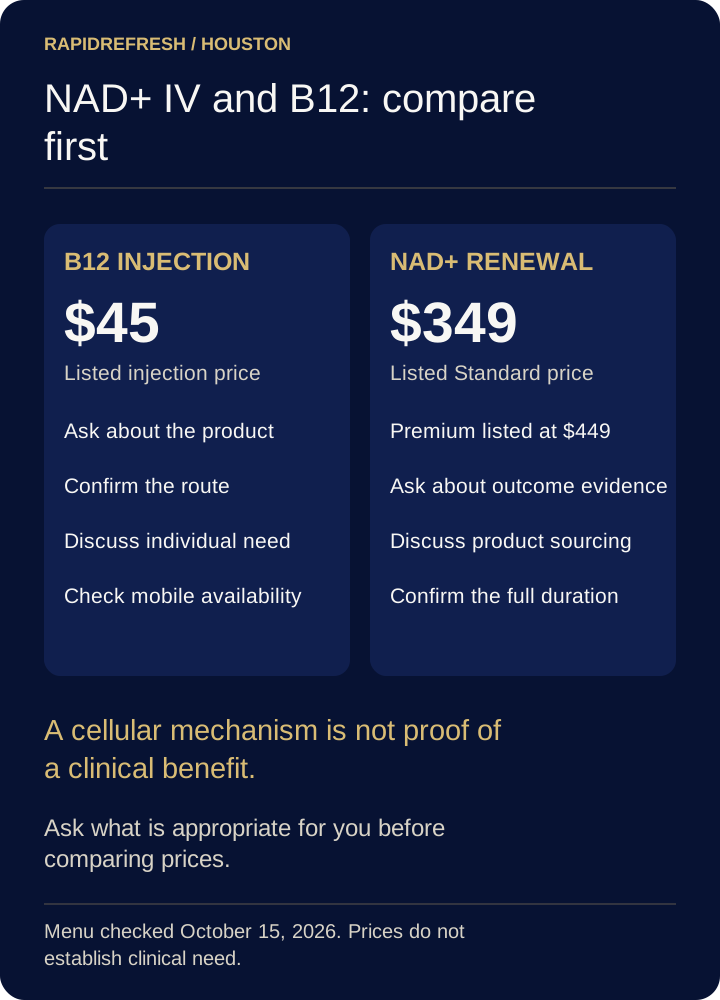
RapidRefresh currently lists Vitamin B12 Injection at $45. NAD+ Renewal is listed at $349 Standard and $449 Premium. The difference between the Standard NAD+ figure and the B12 injection figure is $304; the difference between NAD+ Standard and Premium is $100. Those are arithmetic comparisons of named menu entries, not a cost-effectiveness analysis. A more expensive service is not automatically more appropriate or more effective. Before evaluating value, you need to understand what is being proposed, whether it addresses an appropriate goal, and what the complete appointment would involve for your circumstances.
| Question | B12 Injection | NAD+ Renewal |
|---|---|---|
| Listed menu price | $45 | $349 Standard; $449 Premium |
| Service format | Injection; confirm preparation and route | IV service; confirm exact plan |
| Key evidence question | Is there an individual clinical reason? | What outcome evidence supports the proposed goal? |
| Appointment planning | Confirm standalone mobile availability | Confirm full duration and monitoring |
| Travel | Confirm address and final terms | Confirm address and final terms |
The $45 entry also does not automatically confirm a standalone mobile house call at that total. Ask about availability and any visit terms. For NAD+ Renewal, ask what the Standard and Premium distinction actually means in the proposed plan rather than inferring details from the price difference. The public figure does not tell you the full clinical protocol. Request an explanation from the treating team before agreeing to a service. If you are considering repeat appointments, the same questions apply again; a package does not itself establish an appropriate frequency, a clinical rationale, or a reason to continue indefinitely.
Product sourcing is part of the discussion
The FDA has reported adverse events following NAD+ injectable drugs, including severe chills, shaking, vomiting, and fatigue, and has emphasized ingredients appropriate for sterile compounding. This is a general safety alert, not a claim that RapidRefresh supplied an affected product. It is a reason to ask the clinical team about the actual preparation and sourcing rather than assuming that a familiar molecular name guarantees quality. Ask who can answer product-specific questions and what the response process would be if you experience a problem during or after an appointment.
The FDA's compounding overview also explains that compounded drugs are not FDA-approved. Do not confuse the regulatory status of a particular finished preparation with the status of an ingredient, a facility, or a different product. The right question is specific: "What exactly would I receive, who prepares it, and how is its suitability assessed?" A promotional phrase such as "medical grade" does not answer those details by itself. You do not need to become an expert in manufacturing regulation, but you should be able to get a clear explanation of the product being proposed.
Discuss symptoms before choosing a menu item
If you are searching because of ongoing fatigue, reduced concentration, or a change in how you feel, tell an appropriate clinician rather than treating the menu as a diagnostic tool. Neither the word "energy" nor a higher price identifies the cause of a symptom. Bring an accurate list of your medicines, supplements, previous reactions, and relevant conditions to the designated clinical intake. Explain any existing treatment or recent assessment. Do not stop prescribed care to prepare for an elective service, and do not combine services simply because both appear in the same online category or share a marketing theme.
Ask what would make the clinical team recommend against the appointment and what alternatives should be considered. A balanced conversation includes uncertainty, limitations, and the possibility of another type of care. It should not require you to arrive already committed to a product. If the team advises evaluation elsewhere, that advice is part of an appropriate response. If you are experiencing an emergency, call 911 rather than waiting for a wellness booking reply. Convenience is valuable when it supports suitable care; it should not be used to bypass a necessary assessment or create pressure for an immediate elective decision.
Plan the Houston appointment realistically
A research infusion lasting six hours does not establish the duration of RapidRefresh's NAD+ appointment. Likewise, a brief injection procedure does not mean the complete B12 visit requires no assessment or monitoring. Ask the provider how much time to reserve for the actual planned service, including preparation and departure. Explain any hard deadline before booking. Avoid fitting an unfamiliar service between meetings on the assumption that every "energy" option has the same timing. A workable plan should allow the clinician to explain the procedure and respond to questions without competing with a train of errands or work calls.
Address confirmation matters too. Houston, Sugar Land, Pearland, and Stafford are on RapidRefresh's core service list. Katy, Cypress, The Woodlands, and the other named extended communities have a travel fee confirmed before booking. Check the service-area page and request the complete quote for your address. Do not assume a higher-priced service includes every possible travel arrangement, or that a lower-priced injection carries the same house-call terms as a full infusion. Ask directly. The purpose of comparing the services is to understand the decision, not to hide logistical questions behind a treatment price.
Use three questions to make the comparison useful
Before requesting either service, ask: "What is the individual reason to consider this?", "What evidence and product information apply to the actual preparation?", and "What would the complete appointment and confirmed total involve?" Write down the answers in plain language. If the explanation depends only on a testimonial, a vague cellular claim, or the idea that more expensive means stronger, ask for clarification. You are not obliged to choose one simply because you started comparing two. Deciding that you need a conversation with your regular clinician, more information, or no elective appointment can be the most useful outcome.
For Houston readers, the difference between NAD+ IV therapy and a B12 shot is therefore more than the gap between $349 and $45. The products, routes, evidence questions, and appointment arrangements are distinct. Use the drip menu to understand the named options and the booking page to ask for the appropriate clinical discussion. Keep the final choice grounded in the actual proposed service and your circumstances. That is a clearer basis for a decision than treating two very different offerings as interchangeable shortcuts to feeling better.