

Start with the question you actually meant to ask
You ask what is in a Myers' cocktail and receive an answer like "B12, magnesium, B-complex, and vitamin C." That sounds specific until you look again. Is B12 not already a B vitamin? What does B-complex include? What is the clear fluid carrying everything? And are all services called Myers' cocktail really the same?
Those are sensible questions. You do not need a medical degree to expect a clear answer about something being put into your bloodstream. Nor should you have to guess whether the person answering is describing ingredients, possible uses, or the benefits advertised on a menu.
This guide works through those questions in order. First, identify the contents. Then understand what the nutrients normally do. Finally, examine the evidence and the practical checks that matter before deciding whether an infusion is appropriate for you. The aim is understanding, not persuading you to book a drip.
What a Myers' cocktail is, and why the name is not enough
Myers' cocktail is a name used for an intravenous vitamin-and-mineral blend. Descriptions commonly include B vitamins, vitamin C, magnesium, and calcium, although modified versions differ. The fluid enters a vein through an IV line under professional supervision. It is not a drink, a single vitamin injection, or one internationally standardized finished product.
A 2002 paper by physician Alan Gaby described a modified version built on the work of John Myers. It helps explain where the familiar ingredient list comes from. The paper includes clinical experience and case reports; its description of a formula should not be mistaken for controlled proof of all the benefits associated with that name.
That last distinction explains much of the confusion. Two providers can use the same name while offering different ingredients, concentrations, carrier fluids, volumes, or optional additions. "Our Myers' cocktail" is therefore the beginning of an explanation, not the complete formulation. The exact preparation must be described by the provider responsible for it.
Think of the name as a category that needs a specification. You would not compare two medicines solely because both were called "pain relief." Likewise, you cannot determine whether two infusions are equivalent from their shared marketing name or the color of their bags. Compare the actual proposed preparations instead.
The three layers of an ingredient list
An IV description becomes easier to follow when you separate three layers: the carrier fluid, the active ingredients added to it, and any other components of the finished products. The clinician or pharmacist must account for the complete preparation, including compatibility and the total amount of fluid you would receive.
- The carrier is the sterile fluid used in the preparation. Its own electrolyte content matters.
- Added ingredients may include individual vitamin products, a B-complex product, and mineral preparations.
- Product-specific components can include stabilizers, preservatives, or other excipients. Ask about these when relevant to allergies or previous reactions.
A short public menu may summarize only the second layer. That is useful for browsing, but an individual discussion should go further. If your question is "What are all the ingredients?", say that explicitly. Ask for the full written description rather than accepting a list of three or four broad categories.

What does B-complex actually mean?
The B-vitamin family contains eight vitamins. MedlinePlus lists the family members and explains their involvement in processes such as using energy from food and forming red blood cells. "B-complex" describes a group, but a particular injectable product may contain only some family members. The product label is what identifies its actual contents.
| Vitamin | Common name |
|---|---|
| B1 | Thiamine or thiamin |
| B2 | Riboflavin |
| B3 | Niacin; some products use niacinamide |
| B5 | Pantothenic acid; injectable products may use a related form |
| B6 | Pyridoxine and related forms |
| B7 | Biotin |
| B9 | Folate; folic acid is one form |
| B12 | Cobalamin; several preparations exist |
This table is a vocabulary guide, not a claim that all eight belong in every infusion. Ask which B vitamins the proposed product contains and whether any are supplied separately. If someone answers "B-complex" again, you can reasonably ask to see the product information or speak with the clinician who can explain it.
Why B12 may be listed separately
B12 is part of the B-vitamin family, but that does not tell you whether it is included in a specific B-complex preparation. A provider may use a product without B12 and add B12 separately. Another preparation may already contain it. What matters is the actual composition and the complete amount, not the number of times the name appears in a message.
The NIH B12 overview explains its roles in healthy blood and nerve cells and the importance of addressing deficiency. It also states that B12 does not improve energy or endurance in people who already get enough. Normal nutrient function and a promised extra benefit from an infusion are different claims.
If someone recommends B12 because you feel tired, ask what supports that recommendation. Fatigue alone does not establish a deficiency. If you already have a diagnosis or prescribed replacement plan, explain that before considering another service. A wellness menu should not quietly replace coordinated medical care or create a second, unconnected treatment schedule.
What vitamin C contributes to the discussion
Vitamin C is also called ascorbic acid. The NIH consumer fact sheet describes its antioxidant role, contribution to collagen production, and support for normal immune function. Those are reasons the nutrient matters in human biology. They do not establish that a Myers' infusion prevents infections, brightens everyone's skin, or speeds recovery from every exhausting week.
Ask how much vitamin C is proposed and why, particularly if you have seen separate advertisements for high-dose vitamin C treatment. Different preparations and quantities should not be treated as interchangeable. A study of one protocol cannot be assumed to validate every product that includes the same vitamin name somewhere on its ingredient list.
You can appreciate a nutrient's importance without assuming that more is better. The useful question is whether the proposed route and amount address an individual need, with risks and alternatives explained. An appealing label such as "immune support" should lead to a more precise conversation rather than ending it.
Magnesium is a mineral, not another vitamin
Magnesium helps with many normal body processes, including nerve and muscle function. The NIH magnesium fact sheet also explains why kidney function matters: impaired kidneys may not remove excess magnesium effectively. That is one reason a clinician needs your health history before recommending a preparation containing it.
The name on a product may identify a magnesium salt rather than simply the elemental mineral. If you compare two written descriptions, ask the pharmacist or clinician to interpret the quantities. Numbers attached to different chemical forms may not be directly comparable. You should not have to calculate a personal dose to understand the proposed plan.
An ingredient's normal role in muscle function is not proof that an elective blend treats every cramp, headache, or fatigue complaint. If a symptom is persistent, new, or unexplained, ask about assessment before fitting it to a menu category. The reason for including magnesium should be individualized rather than inferred from a familiar benefit slogan.
Does it contain calcium as well?
Some descriptions of a Myers' cocktail include calcium; some modified versions omit it. The NIH calcium overview explains its importance for bones and teeth and its involvement in muscle, nerve, and blood-vessel function. Again, a normal biological role does not tell you whether additional calcium is appropriate in your infusion.
If one provider lists calcium and another does not, that difference does not automatically identify a better version. Ask why the particular formulation was selected and whether the carrier itself already contains calcium. This is especially relevant when comparing a saline-based preparation with one using an electrolyte solution that has its own ingredients.
That brings us to the part often left out of the first explanation: the clear fluid. It is not merely empty packaging around the vitamins. Understanding the carrier helps you ask a much better question about what "all the ingredients" actually means.
Normal saline and Ringer's lactate are different fluids
Normal saline is commonly used to describe 0.9% sodium chloride solution. A sodium chloride injection label on DailyMed identifies the product and its use with compatible additives. The number describes the commercial solution, not instructions to prepare it at home. Carrier selection and compatibility belong to qualified professionals.
Lactated Ringer's product information lists sodium chloride, sodium lactate, potassium chloride, and calcium chloride. It therefore contributes electrolytes before any separate additions are considered. Its label also warns that additives may be incompatible. It should not be described as automatically interchangeable with saline for any requested mixture.
Neither choice tells you the whole vitamin formula, and neither is universally "stronger." Ask which actual fluid is proposed, how much, and why it suits your circumstances and the intended preparation. A clinician should explain that in ordinary language. This guide deliberately does not provide mixing quantities, infusion speeds, or a recipe.
| Detail | What to ask |
|---|---|
| Carrier fluid | What is the exact product and total volume? |
| Vitamins | Which individual vitamins and preparations are present? |
| Minerals | Which minerals, in which forms, and why? |
| Additions | Which items are optional rather than part of the quoted blend? |
| Compatibility | Who checks that the finished preparation is appropriate? |
What does the evidence say about the combined cocktail?
One frequently cited placebo-controlled pilot trial enrolled 34 adults with fibromyalgia. Participants received eight weekly infusions of a micronutrient blend or a control fluid. The study did not find statistically significant between-group differences in its reported outcome measures. That limits what can be claimed about superiority over the control.
The trial was small and concerned a specific population and protocol. It does not settle every possible research question, but it also does not prove that the cocktail treats fibromyalgia or improves general wellness in healthy adults. Be cautious when a trial is mentioned without explaining its comparison group, size, and results.
There is an important difference between "people felt better after a visit" and "this ingredient combination caused the improvement." Rest, expectations, the setting, time, fluid, and other care can complicate interpretation. A credible explanation acknowledges that uncertainty rather than using a before-and-after story as if it were a controlled comparison.
Why absorption claims do not answer every question
An IV route bypasses the digestive tract, but "directly into the bloodstream" is not a complete argument for choosing it. The decision still requires a reason for the particular substance, amount, route, and person. Getting something into the circulation and demonstrating a meaningful improvement in health are different questions.
Ask what outcome matters in your case. Is the discussion about a diagnosed deficiency, a need for medical fluid replacement, or an elective experience with uncertain benefit? Those situations should not be blended into a single promise. If the explanation cannot move beyond "better absorption," request a clearer account of the actual clinical goal.
This also helps when you hear that a product "detoxes" the body. Ask which substance, which measurable outcome, and what evidence supports the statement. A vague benefit can sound impressive while giving you no practical way to decide whether the procedure is useful or how a repeat appointment would be evaluated.
When oral fluids or another kind of care may make more sense
Do not assume the choice is between buying a drip and doing nothing. Depending on the concern, appropriate options may include ordinary drinking and eating, an oral supplement recommended by a clinician, investigation of symptoms, or medical treatment elsewhere. The right option depends on the problem being addressed, not simply on which services a provider sells.
If you can drink and are considering a visit mainly because a day has been tiring, ask whether an invasive procedure is justified. If you cannot keep fluids down or feel seriously unwell, the question changes to what assessment you need. A wellness appointment should not delay care that requires diagnostic resources or emergency treatment.
A helpful consultation can end without an infusion. It may identify a simpler alternative or explain why the proposed service is unsuitable. You should feel able to consider that answer without embarrassment. Deciding against an elective procedure after learning more is a successful informed decision, not a wasted inquiry.
What risks deserve a specific conversation?
Any IV involves puncturing the skin and placing material into the bloodstream. Possible problems include infection, vein irritation, fluid leaking into surrounding tissue, and reactions to an ingredient. Explain previous problems with IV access or infusions before the visit. Ask what monitoring will occur and how the team responds if you feel unwell.
The CDC's injection-safety guidance emphasizes appropriate preparation, handling, and supplies. For a patient, the useful question is whether the provider can explain a safe professional process. A tidy room, attractive packaging, and familiar nutrient names do not by themselves establish sterility or appropriate care.
Some risks depend on the actual ingredient quantities and your health. The National Cancer Institute's IV vitamin C review discusses concerns with high-dose protocols in people with kidney disease or G6PD deficiency. That evidence is not a claim that all Myers' preparations use those doses. It shows why the amount and the individual's history matter.
Tell the clinician about kidney or heart conditions, fluid restrictions, pregnancy, breastfeeding, medicines, allergies, and any previous adverse reaction. Ask which factors are relevant to the proposed preparation. Do not assume a questionnaire alone settles suitability, and do not hide information because you worry it might lead to a recommendation against the service.
Where the product comes from matters too
If a preparation is compounded, ask who prepares it, why it is being used, and what product information is available. In the United States, the FDA explains that compounded drugs are not FDA-approved. This is a specific regulatory distinction, not a statement that all IV ingredients or all finished products share one status.
Other countries have their own professional and product requirements. Check the appropriate local regulator and the practitioner's licensing body where you receive care. A statement about American regulation is not proof of authorization elsewhere. Likewise, a vitamin sold as a dietary supplement should not be assumed suitable for injection simply because its name matches a proposed ingredient.
What should an appointment explanation include?
Before proceeding, you should understand the proposed preparation, the reason for considering it, the alternatives, the risks, and the complete charge. Ask who assesses you, who is responsible for the clinical plan, and who administers and monitors the service. Professional roles and prescribing arrangements vary by country, so obtain an explanation specific to the actual practice.
Ask about duration for the complete appointment rather than only the time fluid is running. Assessment, questions, preparation, monitoring, and departure all matter. If you have a fixed deadline, mention it early. A procedure should not be rushed to fit between other commitments, and a promised appointment length should not override a clinical need to change the plan.
You should also know how to raise a concern afterward. Keep the instructions and product details provided for your visit. Seek immediate medical help for severe symptoms such as difficulty breathing, chest pain, collapse, or swelling of the face or throat. Do not wait for a routine booking-message reply if the situation is an emergency.
How to compare a Myers' cocktail with a travel drip
Travel drip, recovery drip, and immunity drip are service names, not universal scientific formulas. A travel-branded preparation might primarily involve fluid, include selected additions, or differ substantially between providers. Ask the same ingredient and suitability questions rather than assuming the name tells you what is in the bag or what outcome it can deliver.
If you are comparing two offers, request a written side-by-side explanation: carrier, volume, ingredients, optional additions, purpose, and total. Keep clinical appropriateness ahead of the question of which name sounds more complete. A longer ingredient list is not automatically a better choice, especially when no individual reason for the additions has been established.
For travel-related symptoms, start by identifying what you are experiencing. Jet lag, sleep loss, dehydration, and an alcohol hangover overlap but are not the same problem. Our guide to jet lag and post-flight recovery explains that distinction and the ordinary steps that often deserve attention before any discussion of an elective infusion.
What about repeat appointments?
Before considering a package, decide what a useful outcome would mean for you. "Feeling healthier" is difficult to evaluate if neither you nor the clinician has agreed what concern is being addressed. A specific clinical question creates a better conversation than an open-ended expectation that every visit should produce a noticeable transformation.
If a repeat plan is proposed, ask when it will be reassessed and what would lead to stopping or changing it. An appointment frequency should not come solely from a subscription calendar. A product being water-soluble, familiar, or available for purchase does not create an individual reason to receive it repeatedly.
Record what was actually given and any problems you experienced, using the information supplied by the practice. Share relevant details with your usual healthcare professional when coordinating care. Do not interpret the absence of an immediate reaction as proof of long-term benefit or use it to justify adding more ingredients next time.
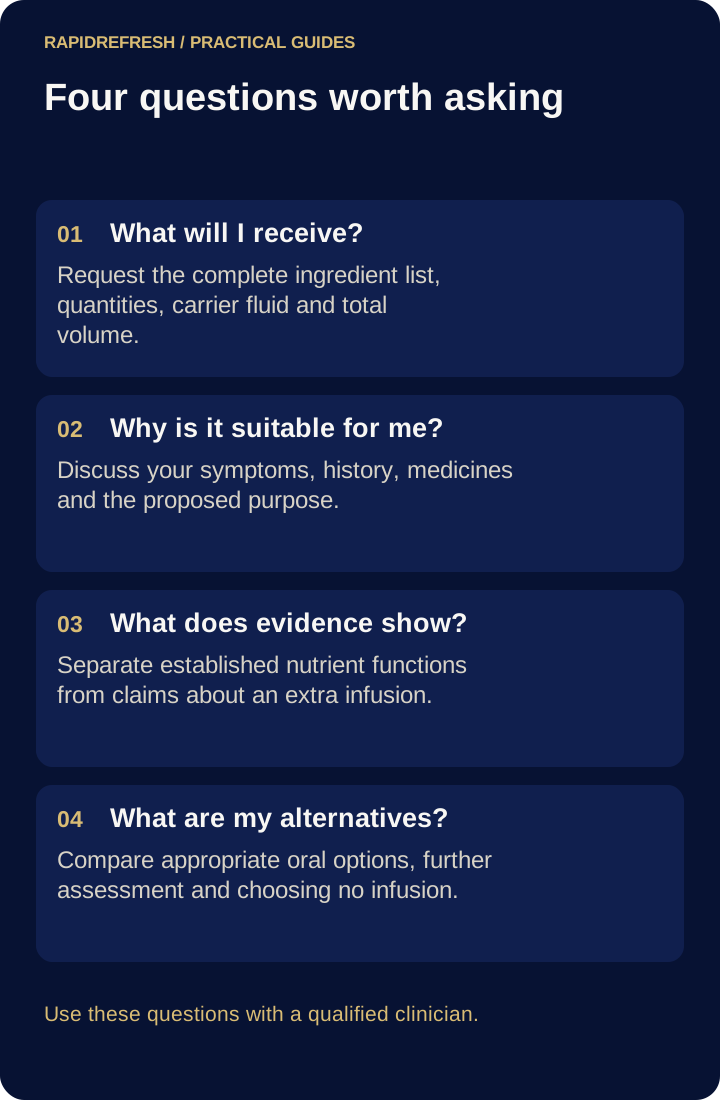
Seven questions you can take to any provider
- What are all the ingredients in the exact preparation you are proposing, including the carrier fluid?
- Which B vitamins are present, and is B12 already included or added separately?
- What are the quantities and total fluid volume, and why are they appropriate for me?
- What evidence supports the particular outcome being discussed, rather than the general importance of vitamins?
- What alternatives would you consider, including oral options or no elective treatment?
- Who assesses, prepares, administers, and monitors the service, and what happens if I have a reaction?
- What does the complete price include, and how would any repeat plan be reviewed?
These questions are not a test you need to pass. They are a way to make an unclear conversation useful. You can ask them without committing to an appointment, without comparing yourself with another customer, and without learning how to calculate a formulation. The professionals responsible for the service should be able to give you a clear explanation.
It can help to send your questions before the appointment rather than beginning a long discussion when equipment is already being prepared. Ask the practice which channel is appropriate for private information and whether a clinical conversation is needed before reserving. That makes room for a considered answer instead of an improvised response under time pressure.
If you receive another abbreviated list, explain the distinction gently: "I understand the main categories. I would like the exact ingredients in the preparation you are recommending, including the carrier and any optional additions." That wording is precise without being confrontational. It helps the professional answer the question you are actually asking, rather than guessing whether you mean benefits, uses, or contents.
What a good answer sounds like
A useful answer identifies the actual products and fluid, explains why they are being considered, and acknowledges uncertainty about benefits. It also makes room for your health history and your preference to decline. It does not rely on "everyone needs it," "more vitamins are always better," or a promise that an infusion will solve unrelated symptoms.
Once you can distinguish the carrier from the additions, B-complex from an individual B vitamin, and normal nutrient function from proven treatment benefit, the menu becomes much easier to read. You can compare information rather than slogans. You can also recognize when an unanswered medical question deserves assessment instead of another product description.
The most valuable outcome is not memorizing a perfect Myers' recipe, because there is no single recipe you can assume everywhere. It is knowing what to ask about the preparation offered to you, what the evidence can support, and what would make you choose an alternative. That understanding travels with you, whichever country or provider you are considering.