

You have landed, but your body has not caught up
The flight is over. You have your bag, a room, and plans you were excited about. Yet your head feels heavy, your appetite is unreliable, and you are either falling asleep before dinner or staring at the ceiling when everyone else is asleep. It is tempting to call the whole experience a travel hangover and look for one fast remedy.
The trouble is that several different problems can feel similar. Your body clock may be out of step with the destination. You may have missed most of a night's sleep. You may have had too little to drink or more alcohol than usual. Sometimes you are becoming ill. One label cannot tell you which response is appropriate.
This guide starts with that distinction, then gives you a practical way to organize the first day. The goal is not a perfect sleep score or a miracle reset. It is to make the next decision easier, avoid remedies that create new problems, and recognize when feeling unwell deserves medical attention rather than another travel hack.
First, separate four problems that often overlap
The CDC Yellow Book describes jet lag as a mismatch between the internal body clock and local time after rapid travel across time zones. It is not simply a synonym for low energy. That is why a long flight largely within the same time zone can leave you exhausted without producing classic circadian jet lag.
Travel fatigue includes the disruption of the journey itself: early alarms, poor sleep, connections, carrying luggage, and an unfamiliar routine. Dehydration concerns a shortfall in the fluids your body needs. An alcohol hangover follows alcohol use. These can occur together, but fixing one does not automatically fix the others.
| Possibility | A useful question | What the distinction changes |
|---|---|---|
| Jet lag | Did I cross time zones and become sleepy at the wrong local hours? | Think about timing of sleep and light |
| Travel fatigue | How much sleep and ordinary rest did I actually lose? | Protect recovery time and safe transport |
| Dehydration | Have I had limited fluids or additional losses? | Consider appropriate drinking and assessment |
| Alcohol hangover | Did I drink alcohol before these symptoms? | Avoid more alcohol and unsupported cure claims |
This table is not a diagnostic tool. A symptom can have more than one explanation, and severe or unusual symptoms should not be forced into one of these boxes. Use the questions to organize an ordinary recovery plan, not to rule out illness or decide that a concerning symptom is harmless.
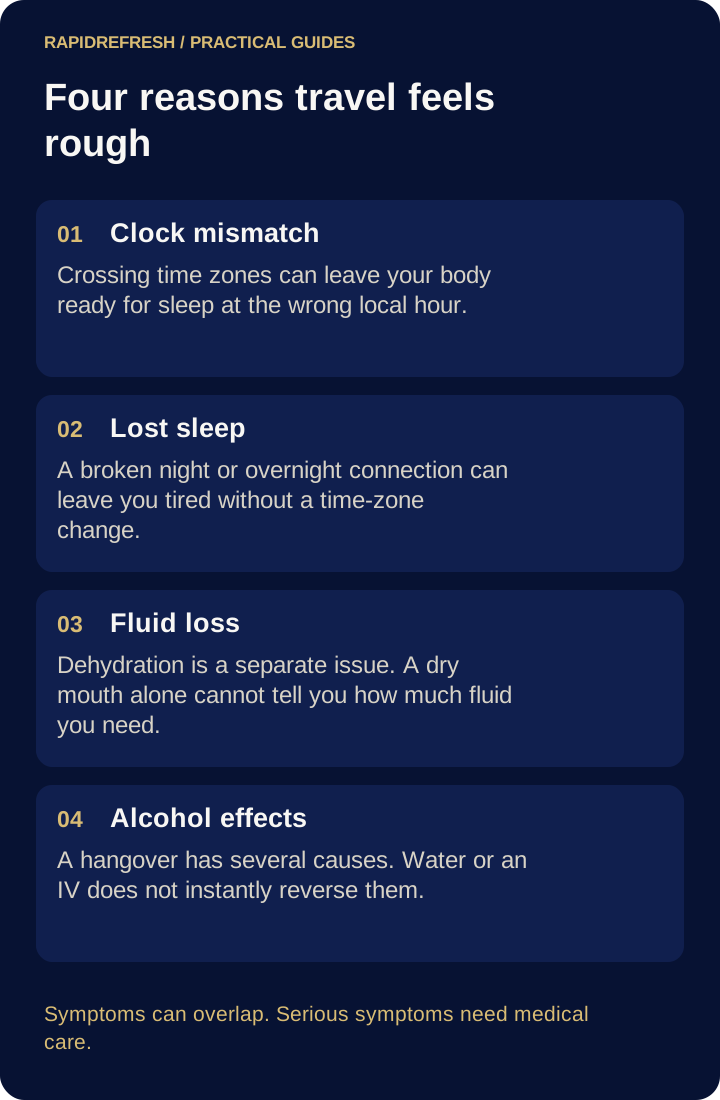
Make the first decision about safety, not productivity
Before deciding whether to take a walk, nap, or answer messages, arrange a safe way to get where you are staying. If you are struggling to stay awake, do not make driving the test of whether you have recovered. Ask someone else to drive or use an appropriate transport option. An important meeting is not a reason to ignore impaired alertness.
This is also the moment to lower the day's expectations. A flexible arrival day is easier to manage than a schedule that assumes the flight created no disruption. If you can change one thing, remove a nonessential demand. Having space to eat, settle in, and make a considered plan is often more useful than buying another product while rushing between commitments.
Set aside essentials before unpacking everything: drinking water, an ordinary meal or snack if wanted, your usual medicines according to your established instructions, and a way to contact help. Keep medication timing questions separate from jet-lag advice; time-zone changes can require specific guidance for some prescribed treatments. Ask a pharmacist or prescriber rather than improvising.
Understand why the local clock can feel wrong
Imagine a destination six hours ahead of home. At 11 p.m. locally, your internal timing may still resemble late afternoon. Knowing you should be asleep does not automatically make sleep happen. This is a time-difference illustration, not a prediction of your exact circadian phase or a schedule for medication and light exposure.
The direction and size of the time change matter, along with your existing sleep pattern and journey. Avoid treating "one day per time zone" as an appointment you must meet. Recovery varies. A simplistic promise can make you worry unnecessarily when your experience does not match it or push you to force a schedule that is not sensible for your circumstances.
Instead, notice a few useful anchors: when you feel naturally sleepy, when the destination day begins and ends, and which commitments truly cannot move. These observations help a clinician or travel-health professional give more specific advice if needed. You do not need to turn the trip into a laboratory experiment to benefit from a clearer plan.
Use light deliberately, without copying a rigid schedule
Light is a timing cue for the body clock. Its effect depends on when it reaches your internal clock, not just the hour printed on a local watch. The CDC's jet-lag guidance emphasizes appropriately timed light and notes that direction of travel and time zones crossed influence the plan. A route-specific approach is more useful than "morning sunlight always fixes everything."
For ordinary travel planning, include opportunities to be outside during the destination day rather than spending every waking hour in a dark room. For a large time shift, an unusual itinerary, or a trip where alertness is particularly important, ask a travel-health clinician about personalized timing. A reputable itinerary-based tool can support planning, but it is not a substitute for clinical advice when your circumstances are complicated.
Keep the practical part easy. Find out whether you can have breakfast near daylight or take a gentle walk in an appropriate outdoor setting. You are creating a manageable daily rhythm, not trying to prove you can tolerate intense exercise while exhausted. Use normal sun, heat, and personal-safety precautions wherever you are traveling.
Protect sleep instead of chasing a single perfect night
The NIH's sleep guidance identifies seven to nine hours as the usual recommended range for adults. That does not mean you can command exactly eight hours on the first night after a major time change. It does mean that an itinerary allowing only a few hours in bed leaves little room for recovery, however carefully you plan the light.
Create a simple sleep opportunity: a quiet room, comfortable temperature, reduced disturbance, and a realistic bedtime plan. If a partner wants to watch a bright screen while you try to sleep, discuss that early. Ask the accommodation about curtains or noise if those are likely to matter. Small logistical choices can make the plan easier to follow.
If you wake at an inconvenient hour, avoid treating that moment as a personal failure. Keep the situation calm and consider what will help you return to your planned routine. Repeatedly checking messages, starting work, and filling the remaining night with stimulating tasks can turn an unwanted awakening into a new obligation you never intended to create.
What about naps?
The NHS jet-lag advice encourages adjusting to local sleep times and avoiding daytime sleep that interferes with the night. The practical tension is that an exhausted traveler may also need rest for safety. Do not force yourself through dangerous sleepiness simply to claim that you stayed awake until dinner.
Distinguish a deliberate rest from an accidental afternoon that becomes an entire sleep period. If you choose to nap, consider whether it will undermine the intended night and set an alarm rather than assuming someone else will wake you. If symptoms are severe, persistent, or unusual, seek advice rather than repeatedly extending daytime sleep without understanding the problem.
Your plan should fit the trip. A relaxed holiday offers different choices from caring for a child or beginning safety-sensitive work. Explain those constraints when asking for individualized guidance. An article can identify the decisions; it cannot decide the best sleep timing for every route, person, and obligation.
Drink for your needs, not for an imaginary reset
Aircraft cabins are dry. The CDC's air-travel chapter describes typical cabin humidity of about 10% to 20%, which can dry the eyes and upper airways. A dry mouth or irritated eyes do not, on their own, establish severe dehydration or a need for intravenous fluid.
Make ordinary drinking accessible instead of waiting until you feel miserable and then trying to compensate with a large amount at once. Consider actual fluid losses, including vomiting, diarrhea, or heavy sweating. If you have a medical fluid restriction or another condition affecting hydration, follow your clinician's instructions rather than a generic travel target.
The NHS dehydration guide discusses small sips when feeling sick and pharmacist advice about oral rehydration products for relevant losses. You do not need a sports drink, electrolyte sachet, or wellness infusion simply because you crossed a border. The question is what your circumstances require, not which product is most prominently advertised at arrival.
Eat something manageable and give the day a shape
Travel can make meals erratic. You might have eaten because the cabin lights came on rather than because you were hungry, or skipped food while making a connection. On arrival, choose something ordinary that you can tolerate. There is no need to find a special detox meal before you are allowed to settle in.
Use meals as practical anchors for organizing the destination day, while allowing for appetite and your usual health needs. A simple breakfast plan can also create a reason to get out of the room and begin the morning. If you have diabetes or another condition with specific food and medication requirements, use your established clinical plan and ask for advice about time-zone changes.
Avoid turning discomfort into a contest between extreme remedies. Skipping food for a long period, forcing an enormous meal, or stacking supplements because the flight was tiring adds complexity without necessarily addressing the problem. A manageable meal and a less ambitious schedule often make it easier to think clearly about the next step.
Caffeine can support alertness, but it cannot replace sleep
Before reaching for another coffee, ask what time you hope to sleep and how sensitive you usually are to caffeine. A drink that helps you through a morning task can become an obstacle if you keep using it late into the destination evening. Consider the whole day rather than treating every dip in alertness as a separate problem requiring another stimulant.
The CDC's aircrew guidance advises avoiding caffeine and alcohol before sleep and planning for sleep disruption. Caffeine is not evidence that you are safe to drive or perform demanding tasks while very tired. If staying awake requires repeated rescue strategies, reduce the demand rather than assuming you have restored normal functioning.
A practical approach is to decide on your caffeine plan before the afternoon slump arrives. Notice what you have already consumed, including energy drinks and unfamiliar products. You do not need to add a new high-dose supplement to an already disrupted day. Keep the choices familiar and leave room for the sleep opportunity you are trying to protect.
Is melatonin worth considering?
The National Center for Complementary and Integrative Health reports that melatonin may help some people with jet lag. It also notes interactions, uncertainty about long-term use, and differences between labeled and actual contents in some supplements. "Natural" does not mean that any product or timing is right for everyone.
Timing matters, and guidance and access rules differ between countries. Ask a clinician or pharmacist about your itinerary, existing medicines, and relevant health conditions rather than copying another traveler's dose or bedtime. This guide does not provide a universal melatonin schedule. Pregnancy, breastfeeding, childhood, epilepsy, or blood-thinning medicines are examples of circumstances that deserve specific professional advice.
Keep any product safely away from children and do not treat a gummy as an ordinary sweet. Do not add a borrowed sleeping tablet, combine sedating products with alcohol, or take an extra dose simply because you remain awake. If you are unsure whether a product is appropriate, resolving that question is more useful than experimenting while already tired.
If alcohol is part of the picture, name it separately
An alcohol hangover can overlap with jet lag, but it is not the same mechanism. The NIAAA hangover guide explains that disrupted sleep, stomach irritation, inflammation, and mild dehydration can contribute. Symptoms may last 24 hours or longer. Rehydrating does not erase all those processes or establish that you are ready to drive.
There is no proven instant hangover cure. More alcohol, coffee, a cold shower, or a wellness infusion should not be presented as reversing the whole condition. Be cautious with pain medicines after drinking: alcohol can create particular concerns with acetaminophen, while some other common painkillers can irritate the stomach. Ask a pharmacist about your situation instead of stacking remedies.
For the next leg of the trip, consider whether avoiding alcohol would simplify recovery and sleep. That is a different decision from searching for something to cancel out drinking afterward. If someone is difficult to wake, breathing abnormally, collapsing, or otherwise severely unwell, seek emergency help rather than assuming they only need sleep or a drip.
Would an IV or a vitamin blend help?
The important question is whether there is an appropriate clinical reason for intravenous treatment, not whether the service is called travel recovery. MedlinePlus distinguishes ordinary fluid replacement from severe dehydration requiring medical care. An individual assessment should determine the right setting and approach. A long flight alone does not establish an indication for an invasive procedure.
An infusion should not be described as resetting the circadian clock, replacing lost sleep, or curing an alcohol hangover. If a provider proposes a vitamin blend, ask exactly what it contains, why each addition is considered, and what outcome evidence applies. Our Myers' cocktail guide explains how to read that kind of proposal.
If you can drink and your main problem is being sleepy at the wrong hours, a product focused on fluid cannot answer the whole question. Conversely, if you cannot keep fluids down or are significantly unwell, seeking an appropriate assessment matters more than comparing wellness menus. Keep the clinical problem and the advertised service name separate.
A workable first-day plan
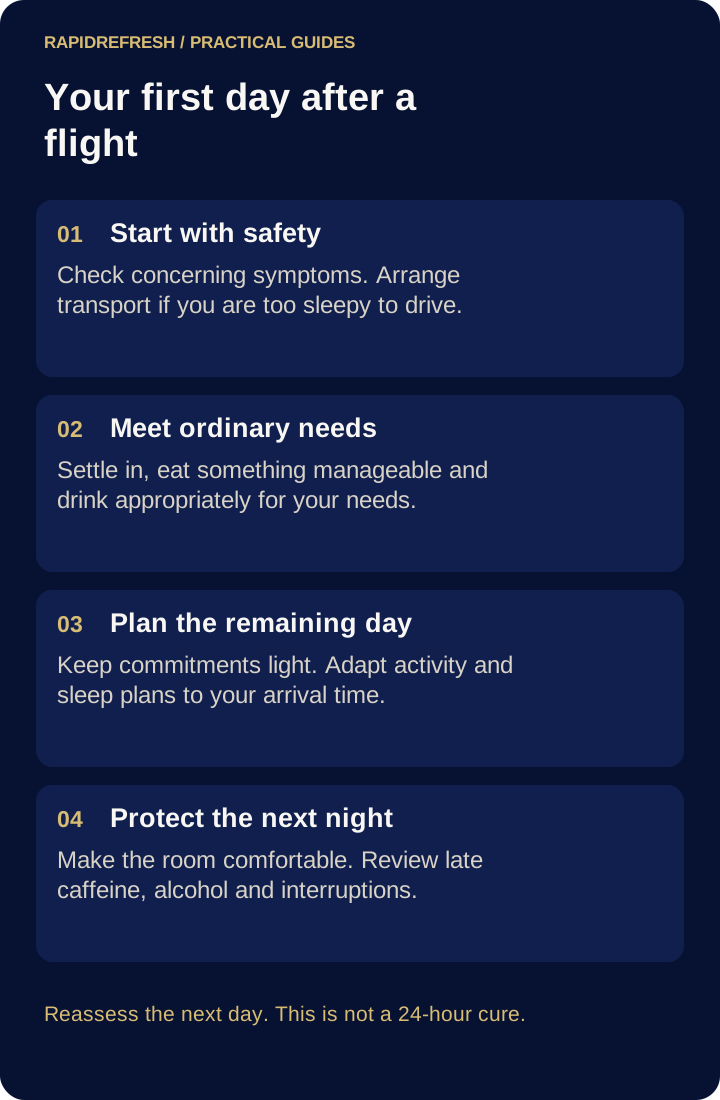
Start with a short sequence rather than an elaborate recovery project. Confirm that symptoms do not require urgent care, arrange safe transport, and settle somewhere you can meet ordinary needs. Then decide how the remaining destination day and the next night should look. Leave room to change the plan if you feel worse or receive different clinical advice.
- On arrival: check how you feel, avoid driving if too sleepy, and make essential medicines and contact information accessible.
- Once settled: drink appropriately, choose manageable food, and reduce nonessential commitments.
- During the destination day: consider suitable outdoor time and a gentle routine; do not force unsafe wakefulness or intense exercise.
- Before the intended night: limit avoidable disturbance and reconsider late caffeine, alcohol, and unnecessary screen-based work.
- The following day: review whether sleep, alertness, appetite, and ordinary function are improving rather than expecting one remedy to solve everything.
This sequence is intentionally flexible. A person arriving early in the morning and someone arriving near bedtime need different details. So do a solo traveler and a parent supervising children. Use the framework to identify what needs planning, then adapt it to your itinerary rather than treating the list as a clinical prescription for a particular hour.
Plan for short visits and the trip home
Before you leave, put a few useful details in one place: your arrival time, accommodation check-in time, transport arrangements, and any commitments that cannot move. Keep essential medicines and a change of clothes accessible. None of this changes your body clock, but it removes small problems that become surprisingly difficult when you are tired.
Imagine landing at breakfast time after barely sleeping. You may have hours before your room is ready. Asking about early check-in or a quiet place to rest beforehand gives you an option beyond carrying luggage around all morning. Leave sightseeing flexible. If you need to sleep for safety, a rigid plan to stay awake is not worth following.
Now imagine arriving shortly before the local bedtime. A complicated dinner reservation, late work call, and unpacking every bag can consume the quiet evening you meant to protect. Prepare only what you need for the night and following morning. The rest can usually wait. These examples concern practical planning, not a universal schedule for light exposure or melatonin.
If you are traveling with someone else, agree on which tasks each person can handle on arrival. One person might organize transport while the other checks the room arrangements. Families may need a much slower first day than solo travelers. A workable plan leaves space for the people making the journey, not just the times printed on the ticket.
On a very short trip, completely changing your schedule may not be practical. Consider the total journey, including when you return and what you must do at the destination. Ask for route-specific advice if keeping part of your home routine might be appropriate. There is no universal instruction to stay on home time regardless of local obligations.
Think about the return leg before departure, not only when you are already exhausted. Leave a little margin before driving, demanding work, or important responsibilities if you can. Put the same practical care into the homecoming that you put into the outbound flight. A good plan accounts for two transitions instead of assuming the second one will take care of itself.
When this is not just a rough travel day
New chest pain, difficulty breathing, fainting, or severe confusion needs urgent medical attention. The CDC's travel and blood-clot guidance also identifies concerning leg symptoms and symptoms of a clot in the lungs. New one-sided leg swelling, pain, or warmth after prolonged travel deserves prompt assessment rather than a massage or a routine wellness booking.
Fever or illness after travel needs attention too. The CDC's after-travel advice emphasizes telling your healthcare professional where you have been. Include the destinations and dates, even if the illness appears after returning home. Do not assume that all post-flight tiredness, headache, or stomach trouble belongs to the body-clock problem.
Seek medical advice if you are unable to keep fluids down, have markedly reduced urination, or are getting worse rather than gradually improving. Use the appropriate urgent or emergency services where you are. You do not need to wait for a nonurgent provider to answer a message before obtaining help for a serious situation.
Make the next journey easier without chasing perfection
Before the next flight, ask what created the most difficulty this time. Was it the overnight connection, a day packed with obligations, poor room conditions, or an unrealistic expectation that you could sleep anywhere? Choose one or two changes you can actually make. A simpler itinerary or a protected arrival afternoon may be more useful than a collection of remedies.
If travel repeatedly disrupts sleep or functioning, consider a travel-health or sleep-medicine consultation. Bring the routes, timing, and the problems you encounter rather than only the names of products you have tried. That gives the professional a better starting point for tailored advice, especially if you travel frequently or have an existing condition affecting sleep.
You do not have to solve the whole trip in one sitting. Identify the problem in front of you, meet ordinary needs, protect safety, and give sleep and timing a realistic place in the plan. Feeling better after a flight is often a series of sensible decisions. The useful remedy is the one that fits the actual problem, not the one with the strongest promise.