

Treat the idea as a request before treating it as an event
An office manager considering mobile IV appointments for four to eight people in Houston's Energy Corridor has a different problem from someone booking a single home visit. The clinical service is individual, but the organizer must coordinate a room, access, schedules, costs, and communications. Start by asking RapidRefresh whether the proposed date and headcount are feasible. Do not announce an event on the company calendar before the provider confirms the arrangement. A small interested group does not guarantee a nurse, a particular time window, or the ability to see everyone together. Begin with a request that can be evaluated honestly.
Describe the workplace precisely: full street address, suite, approximate number of interested adults, preferred date, and whether the request is employer-paid or individually paid. Mention any fixed operating hours or meeting constraints. "Energy Corridor" helps describe the general setting, but it is not an entrance instruction or a confirmed travel category. An office near I-10 and Eldridge can have different visitor procedures from a smaller building near Briar Forest. The Houston service page and corporate-events page provide starting points; the actual arrangement still needs confirmation for your building and your group.
Establish voluntary interest without collecting health details
Ask whether people are interested in learning about an elective appointment, not whether they are willing to participate in a public team challenge. Make it easy to decline without explanation. A work-sponsored activity can create pressure even when the organizer intends it as a perk. The signup process should not ask staff to explain fatigue, medications, diagnoses, or why they do not want an IV. An administrative interest list can contain the information needed to coordinate contact and scheduling. The clinical team should tell each interested person how to complete the relevant private assessment process.
The HHS guidance on workplace wellness and HIPAA explains that privacy-rule coverage depends on how a program is structured; information collected directly by an employer outside a group health plan is not automatically protected by HIPAA. Do not promise blanket legal protection because the word "wellness" is on the invitation. Ask the provider how clinical information is handled, and ask your own HR or legal advisers about the employer's role when necessary. A practical privacy precaution is to keep medical information out of the organizer's shared spreadsheet in the first place.
Confirm the room before counting the chairs
A conference room may look spacious but still be wrong for the appointment plan. Tell RapidRefresh about the room's size, access, privacy, available seating, and any restrictions on its use. Ask whether the clinician can assess and monitor participants appropriately there. Do not assume a reception area, open-plan office, warehouse aisle, or sunny outdoor terrace will work because a table fits. A smaller private room may be more useful than a large public space. The clinical team should decide whether the setting is suitable rather than being expected to adapt to whatever is left after meetings are scheduled.
The CDC's injection-safety guidance addresses safe preparation and handling. For an office organizer, that supports a straightforward division of responsibility: provide the agreed setting and access, while qualified personnel manage the clinical equipment and procedures. Do not ask employees to unpack medical items, mix products, or help with sharps to speed up the schedule. Confirm who brings what, where supplies can be kept, and how the room will be left afterward. Keep regular food service, visitors, and office traffic outside the work area during setup and care.
Build a schedule from confirmed capacity
Four interested employees do not automatically equal one hour of appointments. Ask how many people the confirmed team can assess and monitor, whether visits must be sequential, and what time is needed for setup and departure. A useful hypothetical illustrates the difference: if four visits were sequential and each reserved 60 minutes, that alone would account for 240 minutes, or four hours, before any separate setup allowance. This is scheduling arithmetic, not RapidRefresh's promised duration or staffing model. The actual plan may differ. The point is to ask for a schedule instead of assuming every chair can be occupied at once.
Work backward from real workplace constraints. If the room must be free at 3 p.m., that deadline needs to be part of the initial request. If two employees can only attend during lunch, tell the provider rather than assigning them to a slot after the plan is finalized. Keep the schedule flexible enough for an individual review to take longer or for someone not to proceed. Do not tell staff that they must finish quickly to avoid disrupting the next appointment. The clinical team, not the meeting calendar, determines whether and how an individual service can be delivered.
| Planning item | Useful detail |
|---|---|
| Headcount | Interested adults, not assumed eligible participants |
| Timing | Preferred date, room availability, and hard deadlines |
| Room | Privacy, seating, access, and normal room traffic |
| Building | Visitor registration, parking, suite, and elevator |
| Payment | Employer or individual payer and written quote |
| Clinical process | Separate private intake for each person |
Make the budget clear without inventing a group discount
RapidRefresh's public pricing page lists per-session figures, while group and event pricing is quoted separately. You can use the menu to frame a budget discussion, but do not announce a discount or an event minimum that the business has not confirmed. For a transparent arithmetic example, four Standard Essential Hydration sessions at the listed $169 rate have a menu subtotal of $676; eight would be $1,352. These figures are not an event quote and do not establish staffing, clinical suitability, or any separately agreed costs. Include those qualifications if you circulate a preliminary budget internally.
Ask what the written quote includes and what happens if the final number of participating people changes after clinical screening. Clarify the payer, invoicing or payment method, selected services, travel terms, and rescheduling arrangements. If a company pays for a basic service and an employee considers additional options, settle how that difference would be handled without sharing private clinical details with the employer. A budget owner needs enough information to authorize spending. That is different from needing the medical reasons behind each person's final plan. Agree on the administrative process before anyone feels pressed to decide in front of coworkers.
Resolve visitor access before the nurse leaves
Some Energy Corridor buildings require a visitor list, a reception check-in, parking instructions, or elevator access. Ask the property manager what applies to your office and send only the required visitor details through the approved process. Include the correct street entrance and suite. A contact person should remain available during arrival rather than disappearing into a meeting with the only working access badge. Tell the provider if a certificate of insurance or other building documentation is requested so the business can confirm whether it can meet the requirement before the visit is promised.
For travel planning, Houston TranStar's traffic map shows road conditions, incidents, closures, and other travel information. It can inform logistics but does not guarantee a nurse's arrival time. Avoid presenting a fixed drive-time estimate as a service promise. If building access or a road situation changes, notify the provider promptly. A visitor entrance closure may matter more than the shortest route shown by a map. Treat the arrival window as part of a coordinated schedule, with a clear contact process if either side needs an update.
Communicate accurately with employees
An effective invitation describes an optional opportunity to request an individual clinical appointment, subject to review and provider confirmation. It should explain the setting, the relevant time window, the payment arrangement, and how to contact the clinical team privately. Avoid claims that an IV will improve productivity, prevent sick days, cure a condition, or compensate for inadequate breaks and excessive working hours. Those outcomes are not established by holding an event. Ordinary workplace supports such as access to drinking water and reasonable breaks should not depend on purchasing or accepting an elective clinical service.
Photography needs a separate conversation as well. A room full of coworkers can make it easy to forget that a clinical appointment is a private experience. Do not put a photographer in the room by default or assume participation authorizes social-media use. Ask people separately about any proposed images, and make refusal easy. The same principle applies to public lists of who received what. An office can acknowledge that it offered an optional service without identifying individual treatment decisions. The organizer's job is to create a clear opportunity, not to make every employee's participation visible to the team.
Finish with a confirmed plan rather than an enthusiastic placeholder
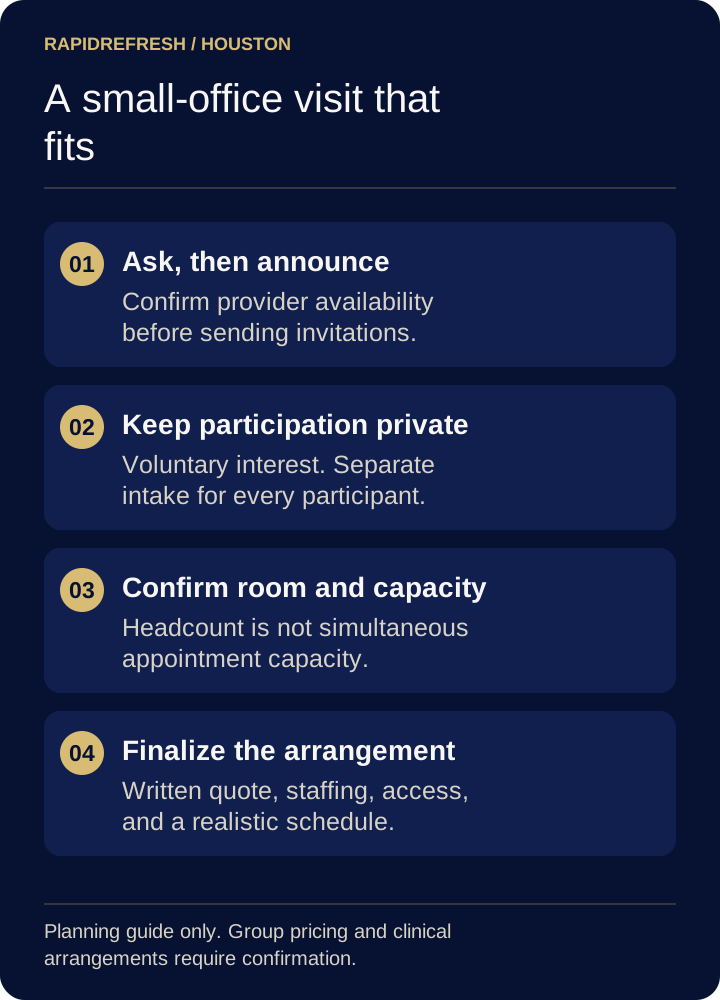
Before sending the final calendar invitation, obtain agreement on five things: provider availability, clinical intake arrangements, the room and access plan, the appointment schedule, and the quote. Keep a named administrative contact on each side. If the business advises that the headcount or timing is impractical, change the plan rather than compressing assessment or monitoring. A small office event should remain manageable when someone has a question, chooses not to proceed, or needs a different recommendation. That flexibility is a sign of sound planning, not a failure to fill every slot.
Use the corporate and group inquiry page to start the conversation, and provide the specific Energy Corridor address instead of a broad "west Houston" description. A carefully planned four-person request can be clearer than an ambitious eight-person calendar block with no private intake or room approval. The right outcome may be a smaller visit, individual appointments on another date, or no elective service for some interested people. What matters is that the people, the clinician, and the workplace understand the arrangement before the first supply bag enters the building.