

Prepare information before you prepare the room
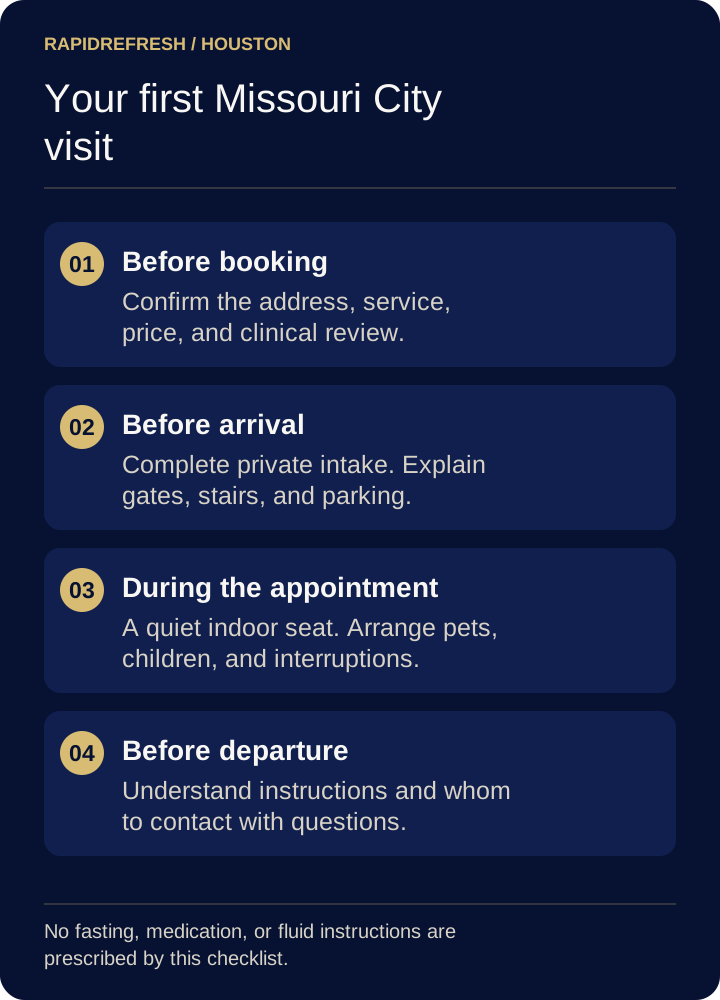
For a first mobile IV visit in Missouri City, the most useful preparation is a clear conversation before anyone travels. Confirm what you are requesting, where the visit would take place, how the clinical intake works, and what the total would be. A completed request form is not the same as a reserved appointment or approval for treatment. Ask what still needs review. If you are in Sienna, Quail Valley, or another part of the 77459 area, provide the complete address rather than assuming the neighborhood name identifies one entrance or one travel route. The business can then confirm coverage and availability for that actual location.
RapidRefresh lists Missouri City as part of its core service area, where travel is included. That policy is different from the extended-area terms for places such as Richmond or Friendswood. Check the Missouri City service page and confirm the address directly if you are unsure. This matters for customers near a boundary or using a broad mailing label. You do not need to work out a radius yourself. You do need the street, ZIP code, unit if relevant, and a way for the nurse to reach you when arriving.
Build a complete medication and supplement list
The Agency for Healthcare Research and Quality's medicine guide recommends keeping a record of medicines, vitamins, and supplements and sharing relevant information with your healthcare team. Prepare that list for the designated clinical intake rather than trying to remember product names at the door. Include nonprescription products you use regularly. If you are unsure about a dose or ingredient, have the packaging available for the clinician to review. A photograph of a label may help the conversation, but use the private channel the practice specifies rather than posting it publicly.
Do not stop a prescribed medicine, take extra supplements, or alter your usual treatment plan to "get ready" for an elective appointment based on online advice. Ask the treating team what information they need and consult your regular prescriber about changes to your ongoing care. Mention previous difficulty with needles or prior reactions so the clinician can discuss the plan realistically. The goal is not to create the perfect application for a service. It is to give the clinical team enough accurate information to decide whether to proceed, modify the proposal, or recommend another option.
Ask about food and fluids rather than inventing a ritual
You may see preparation advice online telling everyone to fast, drink a fixed large amount, or take a particular supplement first. Do not copy a routine intended for someone else's procedure. Ask RapidRefresh for instructions specific to the planned visit and your health history. A clinical team should be able to explain whether there are any individual preparation steps. This guide does not prescribe a fluid target or a meal schedule. It also does not recommend using an IV to compensate for intentionally skipping ordinary food, sleep, or drinking water before a busy day.
The National Center for Complementary and Integrative Health cautions that dietary supplements can interact with medicines and can create risks for some people. Its guidance concerns dietary supplements taken by mouth; it is not proof of the safety or effectiveness of an injectable product. The practical point here is disclosure. Tell the clinical team what you already take and what you are considering adding. Do not assume that a familiar vitamin name makes a proposed IV ingredient automatically appropriate for your circumstances or equivalent to an oral product.
Choose a place where the nurse can work
A quiet indoor chair or sofa with space nearby is a better starting point than a crowded kitchen counter or a patio during a gathering. Think about the route from the door to the seat, lighting, and room for equipment. Clear ordinary clutter, move loose cords, and choose a spot where you can remain comfortably seated while the nurse works. You are not responsible for sterilizing the home or buying medical supplies. Ask the practice what it brings and whether there are any specific requirements for the setting. Let the nurse assess whether the space is appropriate on arrival.
Tell the team in advance if stairs, a narrow hallway, a mobility aid, or an elevator will affect access. If the only available room is upstairs, explain that before assuming equipment can be moved there. Keep pets in a separate secure space during preparation and care, even if they are usually friendly with guests. A dog greeting a visitor enthusiastically can still interrupt work. Household preparation is about making the environment manageable, not staging it for a photograph. A simple, accessible room is often easier to discuss than an impressive but impractical setting.
Plan for children, work, and interruptions
A home appointment can reduce the need to drive, but it does not create childcare or eliminate other responsibilities. If you are the only adult supervising a young child, tell the booking team and make an appropriate plan. Do not assume the nurse can watch a toddler, accept a grocery delivery, or answer the door while providing care. The same applies to work. A quiet laptop task might be different from leading a meeting or taking a confidential call. Discuss what you expect to do and be prepared to pause distractions when the clinician needs your attention.
For a hypothetical household in Quail Valley, a workable arrangement might involve another adult handling the school pickup while the person receiving care stays home. For a customer working remotely in Sienna, it might mean blocking the calendar rather than leaving a video meeting running. These are planning examples, not claims about past RapidRefresh customers. The important feature is that one task does not quietly depend on the nurse doing a second job. Decide who will manage children, pets, visitors, and messages so the appointment can remain a focused clinical encounter.
| Clinical conversation | Household information |
|---|---|
| Medicines, supplements, and allergies | Street, ZIP, gate, and unit |
| Previous reactions or needle concerns | Parking and correct entrance |
| Relevant conditions and current symptoms | Children, pets, and interruptions |
| Questions about the proposed service | Chair location and access barriers |
Decide who may be involved in the conversation
If a partner or relative is helping arrange the appointment, decide what role you want them to have. They might handle parking and payment while you speak privately with the clinician. The HHS guidance on family members and friends explains that healthcare information sharing depends on the circumstances and the patient's involvement or preferences. Booking assistance is not a reason to assume every detail belongs in a family thread. Tell the practice if you want an individual conversation, particularly when the person paying is not the person receiving care.
This is easy to overlook when two people share a home appointment request. One person may complete administrative details while the other has different medicines, health questions, or preferences. Each should have their own opportunity to discuss the proposed service and give consent. If a family member needs language or communication support, ask the practice how it can accommodate that need instead of improvising a translation of clinical instructions. Good preparation includes making sure the person receiving care can understand the conversation and can ask questions without pressure from a well-meaning organizer.
Allow time for the whole appointment
RapidRefresh's existing site commonly describes an infusion portion of roughly 30 to 60 minutes, depending on the service. That is not a guaranteed door-to-door appointment length. Arrival, assessment, explanation, setup, monitoring, and departure all need consideration. Ask for a realistic window for the exact service you are discussing. Do not put a hard departure immediately after the shortest number you have read online. If you need to leave for work or pickup at a fixed time, give that deadline before booking so the team can tell you whether the request is workable.
Be equally clear about timing at the entrance. A guest gate that only opens with a call to your phone can delay a visit if the phone is on silent. An apartment complex may have several buildings with similar signs. Specify the correct gate and building, and keep the arrival contact reachable. A landmark such as a nearby school or golf course can be a helpful extra detail, but it should supplement the address rather than replace it. Send access changes before the visit, especially if road work or a closed entrance makes the usual route unavailable.
Confirm what happens if your situation changes
Contact the practice if you become unwell, develop a new concern, or need to change locations before the appointment. Do not simply keep the original reservation and hope the same plan still fits. The team may need to review suitability again, change the schedule, or recommend a different setting. An elective wellness visit is not a substitute for urgent evaluation. If you are experiencing an emergency, call 911. For nonemergency questions about whether to keep the appointment, ask the clinical team through the appropriate channel and do not assume an unanswered message means approval.
Before reserving, review the booking page, the pricing page, and the instructions provided directly for your visit. Have five things ready: your full address, a complete private intake, questions about the proposed service, a workable indoor space, and a schedule that allows the team to do its job. You do not need an elaborate preparation routine. You need accurate information and realistic logistics. That is what turns a first Missouri City home visit from a vague online request into a clear appointment plan that both you and the clinical team understand.